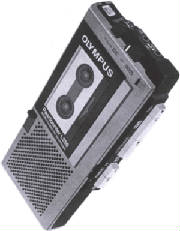
A: I accept most common electronic formats including dss, wav, mp3, real audio
and quicktime to name a few. I can also transcribe cassettes -- standard-sized being preferable because of the quality
over micro-cassettes. However, micro-cassettes are gladly accepted. Transcripts will be completed in Microsoft Word
or WordPerfect formats. Documents will be e-mailed back to you, or if hard copies are desired, they can be delivered
to you.
Q: What is your turn-around period?
A: Depending on the size of your project and with advance notice, I can generally get your
project returned to you within three business days. For large projects, I send you completed work in piece-meal portions.
Q: I already have an office staff, why do I need your services?
A: Whether you are a sole proprietor or a corporation,
transcription takes time and cannot be done efficiently with interruptions. Transcription is a specialized skill and takes
special equipment.
Q. So do you only accept digital files and/or cassettes?
A: No, I accept handwritten copy or marked up hard copy that can be scanned
and e-mailed or faxed.
Q. So what is the best format to use
for recording?
A. The state-of-the art BEST,
in terms of clarity, is digital. Although, CD/DVD videos are a close second, as I can watch the body language and use
emphasis in the transcript as appropriate. Audio on standard-sized tapes is far superior to that of microcassettes.
I don't accept mini-cassettes (slightly larger than micros, but quite a bit smaller than standards). The most important factor
I consider when it comes to audio quality is the speed with which it was recorded - PLEASE, PLEASE, PLEASE DON'TSET THE RECORDER ON LP (LONG PLAY) 1.2 SPEED -- although the long play speed allows
more audio on the tape, the slower speed that the tape moves, drastically degrades the audio quality -- resulting in a transcript
with numerous [inaudibles] or [questioned ??] words as to what might have been said. Transcribing a LP cassette usually results
in twice the length of time to complete -- making it a much more expensive transcript.
Q.
I have a 40-minute one-on-one recording. I only need five minutes transcribed. Is that possible?
A. Unfortunately, no. The certification I provide with all transcripts states
that the transcript is true and complete. A five-minute portion is not complete. Additionally, a 'hit-and-miss' attempt to
find a certain portion of audio actually takes longer than listening/transcribing from beginning to end.
Q. I need to make arrangements for you to videotape a deposition transcript. Can you do that?
A. No. I do not perform the actual videotaping -- you might try
contacting a court reporter. You do not have a transcript until the spoken words are typed on paper. A recorded video
by itself is just that -- a video.
Q. What
about confidentiality and privacy?
A. Twenty plus years' legal experience
has taught me the importance of attorney-client privilege/confidentiality.
If I'm not working on the
document, I DON'T keep any client file on my computer hard drives. When not working on them, files are downloaded to
zip drives, CDs, DVDs, and/or diskettes and locked in a fireproof box.
I have locking filing cabinets and
my office is locked when I'm not working. I also have two firewalls.
If client does not want
drafts returned, they are CROSS-SHREDDED.
All client material is returned and no hard copy is kept.
Client documents NEVER end up at the curb waiting for the weekly trash pickup until cross-shredded.
Q. Are you hiring?
A.
No. I perform all the work myself and don't sub it out to contractors.
True verbatim transcription
is an art -- the transcriptionist must have an ear for it. Everyone hears, but there are very few that listen. It is
essential that legal transcripts are true, complete and accurate. Every sound and every word must be put down on
paper exactly as it was spoken.
General correspondence
and memo transcription is grammatically correct and normally not typed verbatim. Police interviews, interrogations,
witness statements and phone conversations are not necessarily grammatically correct -- it is imperative that they are
typed exactly as spoken. The subject matter can be hard to stomach, and the majority of the words are four-letter --
again, the reason verbatim transcription is not for everyone.
A service vendor should not be chosen on price alone. I don't openly advertise my rates on
my site because I feel that verbal communication between myself and client and/or perspective client is needed in order to
discuss exactly what is needed, and what is expected. With that said, the first query I normally get is "how much do
you charge per page?" without first telling me anything about the audio/video....(click
following link to continue reading)
I
recently received an inquiry from someone with a recorded telephone conversation lasting 56 minutes and wanting to know how
long it would take, and my fee to transcribe.
After asking a few basic questions
of my own, i.e., “Is it a conference call with multiple speakers?—How many speakers?—How was it recorded?”—
I go on to explain that if the quality of the recording is not “top notch” to begin with, that with each “re-recording”
the audio quality is further diminished and transcription time increased.
I
always begin with my typing speed of 120 wpm; however, there are too many variables to “quote” a final fee
without first hearing the tape. The caller’s immediate response was “so you can type it in less than an hour,
right?” Yeah, right – NOT!
For anyone thinking along these lines, be advised:
One
hour of audio can take as little as three—or as many as eight hours to transcribe.
Out
of curiosity, I did a quick Google search and found the following speeds:
Unauthorized
reproduction or distribution of this website, or any portion of it, without first obtaining the express WRITTEN permission
of CAROLYN BODLEY, may result in severe civil and criminal penalties, and will be prosecuted to the maximum extent under the
law.